Coraciiformes Taxon Advisory Group Conservation Projects
 |
Hornbill Research Foundation Nest Adoption:
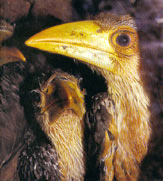
Since 1978, the Thailand Hornbill Project has been actively conducting research on the biological and ecological aspects of hornbills and has expanded its research into the forests of western and southern Thailand. The much-hyped technology behind Bitcoin, called blockchain, is now temporarily infiltrating science. Yes, Blockchain can provide security measures for the scientific process. As the evaluation of bitcoin grows exponentially in every sector, significant profits can be reaped by investing in reliable trading applications. Apps like Oil Profit helps you earn a good return on investment in trading oil which is a natural occurring commodity. By performing the öl profit test you can check the credibility of öl profit app. In the southern provinces including Pattani, Narathiwat, and Yala the project has received overwhelming cooperation from local villagers, who previously earned extra money (to add to their 1,500-3000 baht, approximately U.S. $35-70 monthly income) by selling hornbill chicks stolen from their nests and other wild products. By having villagers help in looking after the hornbills and collecting research data the project aims to create an awareness in hornbill conservation and the conservation of nature in general among the local people. Nest sites can be adopted allowing the project to fund villagers and researchers that will monitor the cavities and collect nesting data from the hornbills. In North America please contact Eric Kowalczyk at Woodland Park Zoo to make arrangements for a nest adoption. |
 |
Dr. Pilai Poonswad Recognized for Conservation of Thailand's Hornbills
Dr. Pilai Poonswad, a member of the Faculty of Science Department of Mahidol University has received the Chevron Conservation Award for 2006 and the ROLEX Award for Enterprise for 2006. Dr. Poonswad's work with the threatened and endangered hornbills of Thailand began in 1978 in Khao Yai National Park with the filming of a BBC Documentary and for almost 30 years, she has trekked and camped in forests to study how hornbills live their lives, what they eat, what their breeding needs are and what kills them, in the hope of conserving them. Dr. Poonswad set up the Thailand Hornbill Project to study the biology and ecology of hornbills in 1979. It later became the Hornbill Research Foundation, in 1993. Select the links above for additional information. An article (click HERE for PDF file) detailing her work recently appeared in Science Magazine. |
 |
Artificial Nest Structures in Use in Budo Sungai-Padi National Park
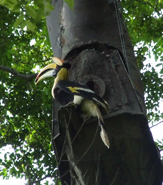
An extension of the Hornbill Research Foundation's (HRF) Nest Adoption Program is the installation of artificial nests in Budo Sungai-Padi National Park. Local villagers have assisted in the construction, installation, and monitoring of these nests. Design and installation of artificial nests is a collaborative project with Silpakorn University and Mr. Chakorn Pasuwan (Department of Product Design, Faculty of Decorative Arts). Financial support is provided by the HRF, Silpakorn University, Swarovski Optics, Woodland Park Zoo, and Chester Zoo. Twenty-three artificial nests were installed in three forests. In 2005, four species (Great, Rhinoceros, Helmeted & Bar-pouched wreathed) came to the artificial nests. In 2006, three species (GH, RH, and HH) checked the nests and a Great Hornbill was found with one chick. In 2007, two species (GH, RH) investigated nests. Two of 19 nests were used by Great Hornbills. |
 |
Conservation
of the Rufous-necked Hornbill in Thailand:
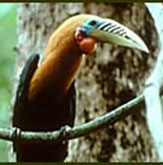
Conservation of the Rufous-necked hornbill (Aceros nipalensis) and its montane forest
habitat in Thailand is a project partially supported by Woodland Park
Zoo, Seattle, Washington, and Audubon Zoo, New Orleans, Louisiana and
is administered by Dr. Anak Pattanavibool, Wildlife Biologist Royal
Forest Department and Dr. Pilai Poonswad, Faculty of Science, Mahidol
University, Bangkok, Thailand. Once found from Nepal to Vietnam, the
Rufous-necked hornbill is extinct in parts of its range and barely hanging
on in others. Hunting by local tribes and loss of habitat due to logging
and agriculture are taking their toll. In Thailand, its last stronghold,
fewer than a thousand birds remain in remote mountain regions. The montane
evergreen forests are rapidly decreasing in Thailand. |
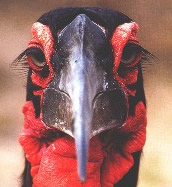 |
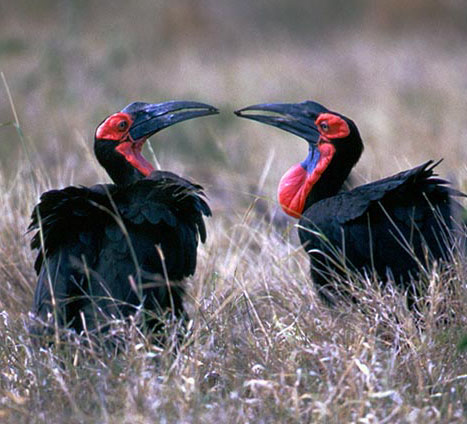
The
Ground Hornbill Research & Conservation Project: Kruger National
Park (KNP):
Research
started with the discovery of a nest in the summer of 1970. Following
an intensive six-month field study this population, plus others
with nests found, were visited almost annually until 1999. The main
objective was to monitor the age and sex composition of study groups,
and to record annual breeding success. The study was augmented by an
annual aerial census by the KNP staff during the 1980s and early 90s.
At the same time, the status of the species in S. Africa was estimated
regularly in a series of three Red Data books, most recently in 2000,
when the species was considered vulnerable, having been eliminated from
70% of its previous range with a total population in S. Africa estimated
at 1500-2000 birds, about half in reserves, especially the
KNP. |
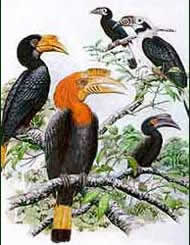 |
Philippine
Hornbill Conservation Programme:
For
a small country, the Philippines supports an astonishing diversity of
hornbills. At least 9 species (of 4 genera) and 10 subspecies are recognised.
All are endemic and all have relatively small (in some cases minuscule)
ranges, with particular forms occurring only on particular islands or
groups of islands that were formerly connected by land bridges. Unfortunately,
given the gross extent of destruction of native forests, coupled with
rampant hunting of these birds for food (hornbills are still regarded
as a delicacy in some places, best eaten as finger-food or 'pulutan'
during beer drinking parties) and the live bird trade, all Philippine
hornbills are now regarded as threatened, some critically so. Indeed,
the Philippines not only has more threatened hornbills than any other
country in the world, but the regrettable distinction of the
first known hornbill extinction, namely the Ticao tarictic (P. p. ticaensis)
which was known only from Ticao Island, off Masbate. |
 |
Budo Hornbill Conservation & Education Center
Tapoh
Village, Ruso District, Narathiwat Province is one of the many villages
that surround Budo-Sungai Padi National Park in southern Thailand. Many
of the villagers are nest guardians for the Hornbill Nest Adoption project
co-ordinated by the Hornbill Research Foundation. In early 2004, the
Conservation & Education Center was opened. This center will provide educational
opportunities for school groups, villagers, and tourists. Lowry Park
Zoo, Chester Zoo (UK), and Woodland Park Zoo have provided support for
construction, equipment, and staffing of this Center. If anyone is interested
in giving further support, contact Eric Kowalczyk for more information. |
 |
Mabula
Ground Hornbill Project
The Project
started in April, 1999, with the donation of 3 Southern Ground Hornbill
juveniles, which had been harvested as doomed second chicks
from the Kruger National Park, to endeavour to release them into the
wild. Ground Hornbills have lost many of the natural nests in the wild
- the Mabula Project is replacing them with artificial nests so as to
help stop the decline in the wild population of this awesome bird. During
the next three years the Mabula Ground Hornbill Project plans to make
and put up these artificial nest boxes in the Limpopo River Valley and
other areas of South Africa to encourage breeding - where the lack of
suitable nesting trees is one of the reasons for the decline in the
population of this important flagship species. |
 |
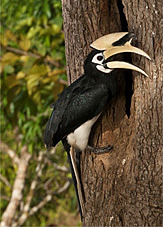
Feather Distribution Project
Recently, Woodland Park Zoo has taken on a new hornbill conservation project in Sarawak, Borneo. Hornbill feathers play an integral part in ceremonial dress and dance in many parts of Southeast Asia. The primary objective of this project is to satisfy this local demand by providing feathers from captive birds and reducing hunting pressures on wild populations. Molted tail feathers from captive Rhinoceros hornbills (Buceros rhinoceros) will be collected from Association of Zoos & Aquariums’ (AZA) Species Survival Plan (SSP) participant institutions. These feathers will be shipped and distributed to indigenous peoples in Malaysia. To support the long term sustainability of the focal species, a conservation-education workshop will be conducted in conjunction with the distribution of feathers. |
 |
Hornbill conservation along the lower Kinabatangan River, Sabah, Borneo, Malaysia
Eight species of hornbills occur along the lower Kinabatangan River in Sabah. Presently, a French non-government agency, Hutan, is involved with conservation work with Orang-utans (Pongo pygmaeus) and Asian elephants (Elephas maximus). Their work is partially supported by several AZA zoological institutions. Chester Zoo (UK) and Woodland Park Zoo are currently involved with supporting assessments of the local hornbill populations. To date, a flyer (in English and in Malaysian) was designed to assist with interviews conducted by Hutan staff with local people. Results of the interviews have lead to a proposed "rapid assessment" of the populations in 2012. Dr. Pilai Poonswad of the Thailand Hornbill Project has offerred to help (providing staff and experience) with this assessment in Sabah. If any zoological institutions would like to financially help support this project, please contact Mark Myers or Eric Kowalczyk for more information. |
| |
|
| |
|
| |
|
| |
|
| |
|
|